
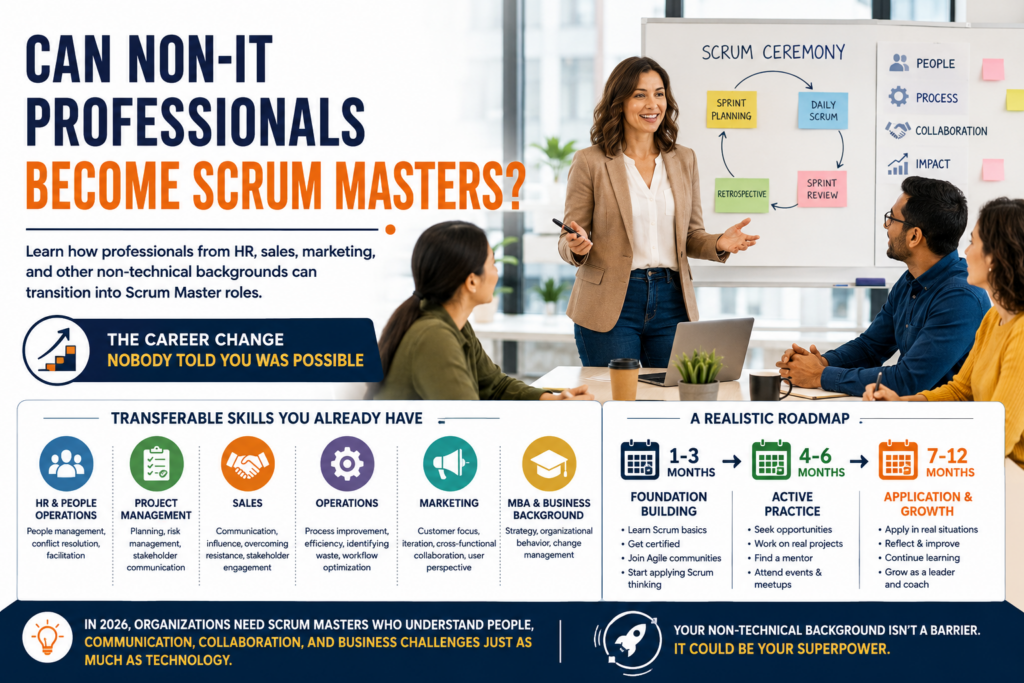
The Career Change Nobody Told You Was Possible
A former HR manager walks into a Scrum ceremony as a certified Scrum Master. She knows nothing about Java. Has never written a line of code. She could not explain what a microservices architecture is if her career depended on it.
Six months later she is one of the effective Scrum Masters on the team. She is even better than the developer who got certified alongside her.
This is not a story made up for effect. It is a pattern that plays out often than people in the Agile community talk about publicly.. In 2026 it is becoming more common not less.
The reason for this is that Scrum is not a framework. It is a framework that operates in technical environments. The skills that make a Scrum Master, such as active listening, conflict navigation, facilitation, coaching and organizational awareness are skills that HR managers, operations leads, project managers, teachers and marketers often have in abundance.
If you are a non-IT professional wondering whether a Scrum Master career path is genuinely accessible to you the honest answer is yes.. It deserves an honest conversation about what it actually takes what the real challenges are and how to build a credible path without shortcuts.
Why Scrum Is Expanding Far Beyond IT
Five years ago you could reasonably say that Scrum was primarily a software development framework. That is no longer true.
In 2026 Scrum is being applied across:
- Marketing teams running campaign sprints
- HR departments managing talent acquisition processes
- Operations teams driving process improvement
- Financial services organizations managing projects
- Healthcare organizations running clinical workflow improvements
- Consulting firms managing multi-client Agile transformations
This expansion is happening for a reason: Scrum works when the work is complex, uncertain and benefits from iterative learning. That describes a lot of work beyond software development.
The result is a growing market for Scrum Masters who’re not just comfortable in technical environments but who can actually bridge the gap between Agile methodology and business domains.
A Scrum Master who genuinely understands HR processes is more effective with an HR team than a Scrum Master who only knows software development. The same applies to marketing, operations, finance and beyond.
This is the reason why the Scrum Master career path is genuinely open to non-IT professionals in 2026. Not because technical knowledge does not matter,. Because Agile methodology is much bigger than any single domain.
The Transferable Skills You’re Probably Undervaluing
Lets talk about what you bring because most non-IT professionals entering Agile dramatically underestimate the relevance of their existing skills.
From HR and People Operations
You know how to navigate performance conversations manage team dynamics, facilitate group discussions and build processes.
You understand what makes people feel heard or not. You know how to handle conflict effectively.
These are some of the important Scrum Master skills there are.
From Project Management
You understand:
- Scope
- Risk management
- Stakeholder communication
- Planning discipline
The adjustment to Agile thinking is real but your project fundamentals are an asset, not baggage.
From Sales
You understand:
- How to read a room
- How to communicate value
- How to handle resistance
- How to keep people moving toward a goal
Stakeholder management in Agile is a lot closer to sales than most people realize.
From Operations
You understand:
- Process improvement
- Efficiency thinking
- How to identify waste in systems
Agile thinking will feel intuitive to you. Your ability to map workflows and spot inefficiencies is directly applicable to helping Scrum teams improve.
From Marketing
You understand:
- Customer perspective
- Collaboration
- Campaign-style iteration
- Working across functions without direct authority
User story thinking often comes naturally to people with marketing experience.
From MBA Programs
You likely have an understanding of:
- Business strategy
- Organizational behavior
- Change management
Agile transformation work at any scale requires this kind of organizational context.
Common Myths About Non-IT Professionals in Agile
Lets address the ones that tend to create unnecessary fear.
Myth 1: You Need to Understand the Technical Work to Be a Scrum Master
You need to understand it to ask good questions and recognize when technical decisions are creating impediments.
You do not need to:
- Code
- Architect systems
- Review pull requests
Many exceptional Scrum Masters have limited technical knowledge but they have enough intellectual curiosity to understand the nature of the technical challenges.
Myth 2: Developers Won’t Respect a Non-Technical Scrum Master
Developer respect is earned through:
- Consistency
- Reliability
- Genuine investment in the teams success
Not through credentials.
The Scrum Master who removes blockers reliably facilitates retrospectives and protects the team from organizational chaos earns deep respect.
Developers do not care if you know Java. They care if you make their work better.
Myth 3: The Scrum Certification Is Just a Test
The certification gives you knowledge.
What teaches you the rest is:
- Practicing Agile
- Seeking coaching
- Joining Scrum communities
- Reflecting on your experience
The certification is the beginning of the journey, not the destination.
Myth 4: Without an IT Background You’ll Get Stuck in Non-Technical Agile Roles
Agile roles in non-IT domains are growing faster than most people realize and often pay very well.
Non-technical Scrum Masters who develop Agile coaching skills regularly end up working with highly technical teams because their human skills are so rare.
A Realistic Roadmap for Non-IT Professionals
Here’s a sequence that works.
Months 1-3: Foundation Building
- Read the Scrum Guide
- Pick a Scrum certification course that fits your learning style
- Complete the certification
- Join an Agile community online
- Start applying Scrum thinking to your role even informally
Months 4-6: Active Practice
- Use your certification to seek out adjacent opportunities
- Work on internal projects
- Take volunteer roles or part-time Agile work
- Find a mentor whos a Scrum Master or Agile coach
- Attend one event or community meetup
Months 7-12: Application and Growth
- Apply Scrum principles to real-world problems
- Reflect on your experiences
- Continue learning and growing as a Scrum Master
To become a Scrum Master you should be honest about your background and confident about the skills you have that can be used in this role.
Your experience outside of the IT field can actually be a valuable thing in certain areas.
Keep learning about coaching and get more certifications to become a better Scrum Master.
Final Thoughts
The path into Scrum and Agile is no longer limited to software developers or technical professionals.
In 2026, organizations need Scrum Masters who understand people, communication, collaboration and business challenges just as much as technology.