
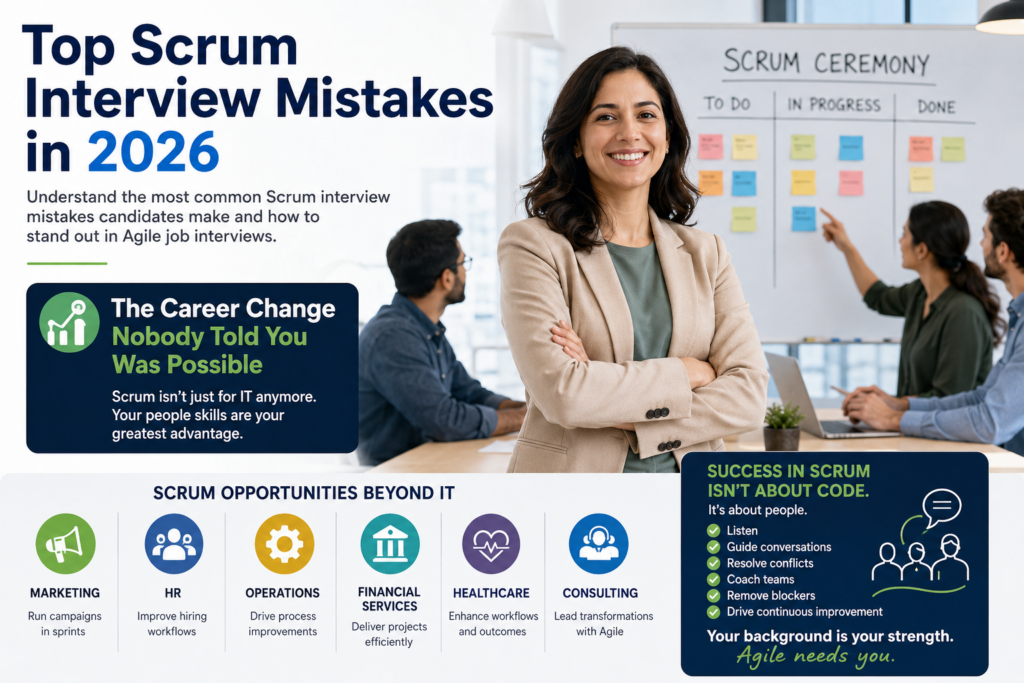
The Career Change Nobody Told You Was Possible
A former HR manager walks into her Scrum ceremony as a newly certified Scrum Master. She does not know Java. She has never written a line of code. If someone asked her to explain microservices architecture she would probably freeze.
A few developers on the team quietly wonder the thing:
- “How is she supposed to lead an Agile team without a technical background?”
Six months later nobody is asking that question anymore. She becomes one of the effective Scrum Masters in the department.
Not because she suddenly learned how to code..
Because she knew how to:
- Listen
- Guide conversations
- Resolve conflicts
- Coach people
- Keep teams aligned when things became chaotic
This is not a rare story anymore.
In 2026 more non-IT professionals are moving into Scrum and Agile careers than before.
Examples include:
- Teachers are becoming Scrum Masters
- HR professionals are transitioning into coaching
- Marketers are joining Agile delivery teams
- Operations managers are helping organizations run transformations
The career shift many people think is impossible is quietly happening everywhere.
Why Scrum Is No Longer Limited to IT
A years ago Scrum was mostly associated with software development. Today that has changed completely.
Organizations now use Scrum across:
- Marketing teams running campaign sprints
- HR departments improving hiring workflows
- Operations teams managing process improvements
- Financial services projects
- Healthcare workflow initiatives
- Consulting and transformation programs
Scrum works well whenever work is:
- Complex
- Fast-changing
- Collaborative
- Uncertain
- Dependent on improvement
That describes far more than software development.
Modern companies are realizing that Agile is not about technology.
It is about helping people work better together.
That is why non-technical professionals are finding opportunities in Agile careers.
The Biggest Misunderstanding About Scrum Masters
Many people still believe a Scrum Master must be highly technical.
That belief stops a lot of professionals from even trying.
But here is the reality:
- A Scrum Master is not hired to be the developer in the room
The role is centered around:
- Facilitation
- Team coaching
- Communication
- Removing blockers
- Improving collaboration
- Supporting Agile practices
- Helping teams continuously improve
Technical awareness helps..
Deep coding expertise is not the core requirement.
Some of the Scrum Masters are people-focused professionals who understand how teams behave under pressure.
The Skills Non-IT Professionals Already Have
Most career changers underestimate how valuable their existing experience actually is.
From HR and People Operations
You already know how to:
- Handle conversations
- Resolve conflicts
- Facilitate discussions
- Support employee growth
- Understand team dynamics
These are Scrum Master skills.
A Scrum team with communication will struggle, no matter how technically strong they are.
From Project Management
Project managers often transition well into environments because they already understand:
- Stakeholder communication
- Planning
- Risk management
- Coordination
- Delivery pressure
The mindset shift from project management to Agile is real..
The foundational experience still matters.
From Marketing
Marketers usually bring strengths like:
- Customer thinking
- Cross-functional collaboration
- Campaign iteration
- Creative problem-solving
- Communication skills
User stories and customer-centric thinking often feel natural to marketing professionals.
From Sales
Sales professionals understand:
- Relationship building
- Persuasion
- Stakeholder management
- Reading people
- Handling resistance
Honestly some Agile conversations require exactly those skills.
From Operations
Operations professionals are often naturally aligned with thinking because they already focus on:
- Process improvement
- Efficiency
- Removing bottlenecks
- Workflow optimization
Helping Scrum teams improve processes becomes much easier with this background.
From MBA and Business Backgrounds
Many MBA graduates already understand:
- Behavior
- Business strategy
- Change management
- Leadership principles
- Team dynamics
These become extremely valuable during transformation initiatives.
The Myths That Scare Non-IT Professionals
Let us clear up some of the fears.
Myth 1: “I Need to Know Coding”
You do not need to become a developer.
You only need:
- Technical understanding to follow team discussions
- Ability to ask intelligent questions
- Understanding of blockers
- Knowledge of how Agile delivery works
Many successful Scrum Masters cannot code.
What matters more is:
- Curiosity
- Willingness to learn
Myth 2: “Developers Won’t Respect Me”
Respect is not earned through jargon.
It is earned through:
- Consistency
- Reliability
- Trust
- Problem-solving
- Supporting the team
If you help developers work effectively they will value you.
Teams remember the Scrum Master who removes chaos, not the one who shows off vocabulary.
Myth 3: “Certification Is Not Enough”
This one is partly true.
A Scrum certification gives you knowledge..
Real growth happens through:
- Practice
- Observation
- Reflection
- Mentorship
- Real team experience
Certification opens the door.
Experience builds credibility.
Myth 4: “Non-IT Scrum Masters Get
Actually Agile roles outside software are growing rapidly.
Companies increasingly want Scrum Masters who understand:
- Business operations
- Customer behavior
- HR systems
- Organizational change
Human-centered leadership skills are becoming valuable not less.
A Realistic Roadmap Into Scrum for Non-IT Professionals
The transition is possible..
It still requires effort and patience.
Here is a realistic path.
Months 1–3: Build Your Foundation
Start with the basics.
- Read the Scrum Guide
- Learn principles
- Take a Scrum certification course
- Join Agile communities online
- Watch real Scrum ceremonies if possible
Importantly begin thinking in Agile ways even in your current role.
Months 4–6: Start Practicing
This is where confidence begins to grow.
Look for:
- Agile projects
- Volunteer opportunities
- Internship-style Agile work
- Cross-functional collaboration
- Mentorship from experienced Scrum Masters
Even small practical exposure matters.
Months 7–12: Gain Real Experience
Once you start applying Scrum concepts in situations things become clearer.
You begin learning:
- Facilitation techniques
- Retrospective management
- Team coaching
- Stakeholder handling
- Conflict resolution in teams
This is when theory slowly becomes capability.
The Part Nobody Talks About
The challenge for most non-IT professionals is not learning Scrum.
It is believing they belong in the room.
Many career changers feel insecure around teams at first.
That feeling is normal.
But over time successful Scrum Masters realize something important:
Technical teams often struggle far more with:
- Communication
- Collaboration
- Alignment
Than with technology itself..
Those human skills are exactly where many non-IT professionals shine.
Final Thoughts
If you are considering a move into Scrum from a -technical background the opportunity is real.
Not because technical knowledge has become unimportant..
Because modern Agile teams need more than technical expertise alone.
They need people who can:
- Guide conversations
- Support collaboration
- Build trust
- Navigate conflict
- Improve team dynamics
- Help organizations adapt to change
Those skills exist far beyond the IT industry.
The career change nobody told you was possible is already happening.
You might be closer, to it than you think.