
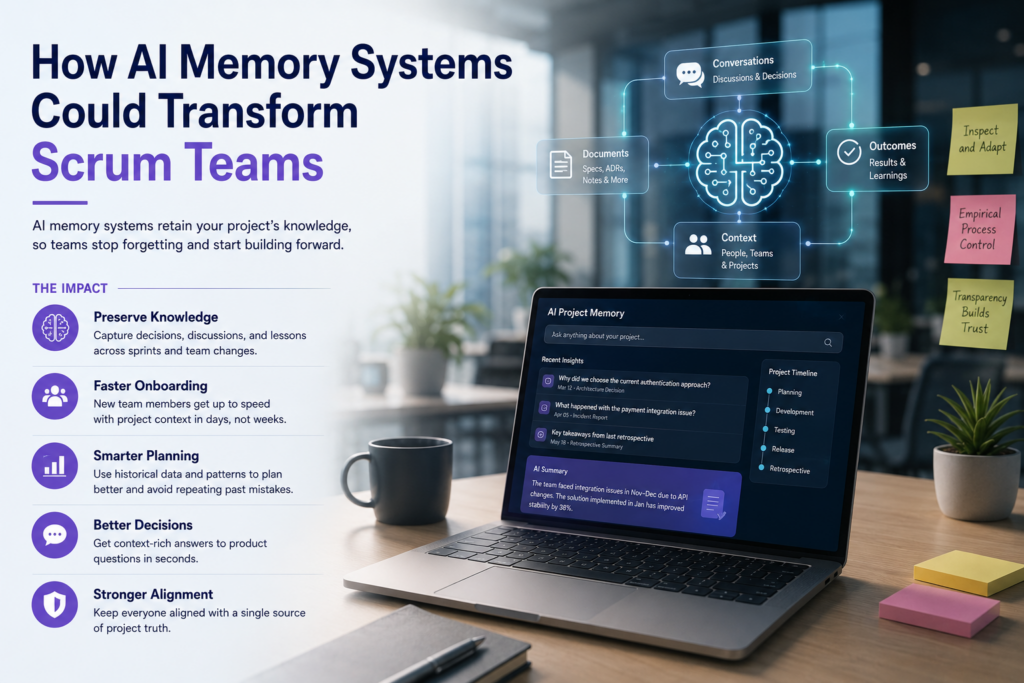
How AI Memory Systems Could Transform Scrum Teams
Introduction
Here’s a scenario I’ve seen play out times.
A Scrum team is six months into a product. They’ve been through a patch with a third-party integration learned from it adjusted their approach and moved on. The lessons are still fresh. The Scrum Master writes them down in the notes. Everyone agrees.
Then the team lead moves on to another project. Two developers leave. A new Product Owner joins. Four months later the team runs into the exact same integration problem. This happens because the teams knowledge that would have warned them about it is buried in a Confluence page that nobody knows exists or in a Slack thread from November that’s hard to find.
This isn’t a failure of individuals. It’s a problem that almost every long-running Scrum team faces.
- Knowledge gets lost.
- Context disappears.
- Teams forget what they’ve already learned.
AI memory systems might be the practical solution to this problem.
What Are AI Memory Systems Actually?
Before diving into the Agile angle lets be clear about what we’re talking about.
Ai tools today don’t remember anything. You open a session ask something get an answer and close the session. The time you come back the tool has no idea who you are or what you’ve discussed before. It’s like talking to someone with short-term memory loss.
AI memory systems are different.
They retain information across sessions.
- Conversations
- Decisions
- Documents
- Outcomes
They retrieve it in context when its relevant.
They can build up a picture of a project over months or years.
They can surface the right piece of history at the right moment.
Think of it like a colleague whos been on the project since day one remembers everything and can answer questions like:
- “What did we decide about the authentication approach March and why?”
- “Have we hit this kind of dependency issue before?”
The Knowledge Problem Nobody Talks About
Every Scrum team I’ve worked with has some version of this problem.
Teams repeat the mistakes across sprints. They do this not because they’re careless. Because the context that would have flagged the risk didn’t make it from last quarters retrospective into this sprints planning session.
Product decisions lose their rationale. Six months after an architectural choice the people who made it have moved on and the people working with its consequences don’t know why it was made that way.
New team members spend weeks getting up to speed. They need to know:
- Why the product works the way it does
- What was tried before
- Whats the story behind a backlog item
Stakeholder requests get acknowledged, logged and then lose their context as they travel through the backlog.
How AI Memory Systems Could Actually Help
Let me walk through where I think the real value lands. Concretely, in the rhythm of a Scrum team.
Keeping Project Knowledge Alive
The obvious application is preserving institutional knowledge across team changes.
Imagine a system that has ingested:
- Every sprint review
- Every retrospective
- Every architecture decision record
- Every significant Slack thread
A new developer asks:
“What’s the history of the payment integration?”
They get a summary:
- Here’s what was originally built
- Here’s what broke
- Here’s the decision that led to the current approach
Onboarding That Actually Works
Onboarding for new Scrum team members is often a mix of document dumps and shadowing sessions.
An AI memory system could change this significantly.
A new team member could spend their days in conversation with something that knows the project deeply.
Sprint Planning With a Memory
Sprint planning sessions are supposed to be informed by history.
In practice they often aren’t.
What if your planning session had access to the twelve months of sprint data?
Retrospectives With a Longer View
Each retrospective is a snapshot.
The real insights are in the patterns across snapshots.
An AI memory system could track themes across retrospectives without the Scrum Master having to synthesise months of notes.
Decision-Making With Context
Product Owners face this constantly:
Someone asks about a product decision and the honest answer is:
“I think we decided X for Y reason but I’m not completely sure.”
An AI system that has tracked the evolution of the products thinking could answer questions like:
“What was the basis for making this feature optional than the default?”
Cutting Down Context Switching
Anyone whos tried to piece the full picture of a complex issue by searching across:
- Jira
- Confluence
- Slack
- Teams
Knows how much time this takes.
An AI memory system that has ingested all of these sources could respond to a question like:
“Whats the full story on the performance issue with the reporting module?”
And synthesise the relevant information.
Potential Challenges
Data Privacy
Project conversations have information about:
- Team members
- Customers
- Business decisions
Any memory system needs access controls.
Teams must think carefully about what gets included and who can access what.
Information Accuracy
AI memory systems can make mistakes.
AI systems present information with confidence. That doesn’t always mean it’s accurate.
A system might:
- Show a decision as if its current
- Misremember a conversation
Teams should treat AI-retrieved context as a starting point for verification not as fact.
Governance
Governance is important.
Questions include:
- Who owns the memory?
- Who can add information?
- Who can delete information?
- What happens when someone leaves the company?
These questions need answers before teams rely on a memory system for context.
Overreliance
There’s a risk that teams stop writing things down because “the AI will capture it.”
Then they discover that the AI captured it in a way that lost details.
The memory system should complement practices not replace them.
What AI Can’t Do
Let me be clear:
AI memory systems won’t replace Scrum Masters or Agile Coaches. Not even close.
The hardest parts of the Scrum Master role have nothing to do with remembering information.
They’re about:
- Building trust in a team thats been through a time
- Reading the room in a retrospective when someone is clearly upset
- Knowing when to let silence sit in a facilitation and when to break it
- Coaching a Product Owner through a stakeholder relationship
- Creating a space where people feel comfortable sharing their thoughts
These require:
- Human presence
- Human judgment
- Human empathy
An AI can surface the fact that retrospective sentiment has been declining.
Only a skilled Scrum Master can figure out why and do something about it.
The teams that will get the most from AI memory systems are the ones that use them to free up energy for the things humans do best.
Not the ones that try to use them as a substitute for facilitation and coaching.
Where This Is Heading
We’re still early in the game.
The AI memory tools available now are imperfect.
Most Scrum teams don’t have processes for integrating them into their workflow.
The direction is clear.
In the term I expect we’ll see AI assistants that can:
- Hold meaningful context across a multi-year project
- Answer questions about it conversationally
- Help teams query project history like they would a colleague
- Track retrospective patterns across years
Out there’s potential for AI that can:
- Make contextual recommendations during sprint planning
- Use historical knowledge to provide suggestions
- Help companies build knowledge assets that persist across teams
- Enable cross-team learning and knowledge sharing
That’s particularly interesting.
One of the wasteful things in large companies is the degree to which different teams reinvent the same solutions.
They make the mistakes because theres no effective mechanism for cross-team learning.
AI memory systems, thoughtfully implemented could start to change that.
Final Thoughts
The knowledge management problem in Scrum teams is real.
Underestimated.
We’ve been trying to solve it with:
- Wikis
- Documentation requirements
- Onboarding programs
- Retrospective templates
They help at the margins.
None of them fully address the underlying issue:
- Context disappears
- Retrieving it is too hard
AI memory systems offer something.
Not just storage, but retrieval that’s intelligent, contextual and conversational.
Not just capturing what happened.
Making that history available in a form that teams can actually use.
The effective Agile teams of the next decade will probably look different from todays.
Not because they’ve replaced collaboration with AI but because they’ve found ways to combine the two.
- Human creativity
- Coaching
- Judgment
Paired with:
- AI-powered memory
- Pattern recognition
That combination.
Humans doing what humans do best.
AI doing what AI does best.
Is where I think the real transformation lies.
The teams that figure out how to make it work will have an durable advantage over those that don’t.
The knowledge your team generates every sprint is valuable.
It’s time to stop letting it disappear.