
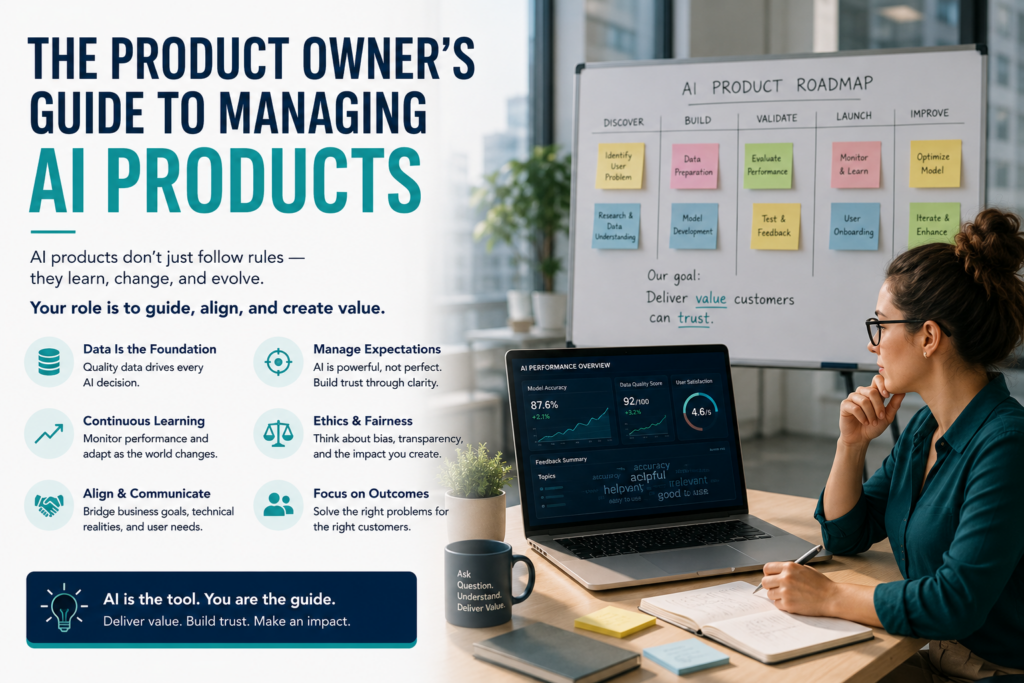
The Product Owners Guide to Managing Artificial Intelligence Products
A years ago managing a product was pretty straightforward.
- You found a problem that customers were having.
- You worked with your team to come up with a solution.
- You tested it.
- You launched it.
- Then you kept making it better based on what customers told you.
- Course managing a product was never really easy.
- Least you knew what you were doing.
- Then Artificial Intelligence came along.
Suddenly Product Owners were working with systems that:
- Did not always do the thing twice.
- They learned from data.
- They changed over time.
- Sometimes they did things that even the people who built them did not fully understand.
If you have ever launched a feature that used Artificial Intelligence you probably know what I mean.
Everything seems fine when you are testing it.
- The people you work with are excited.
- The launch goes smoothly.
Then a weeks later people start asking questions.
- “Why did the Artificial Intelligence do that?”
- “Why is it doing something today?”
- “Why is it not working well as it did last month?”
Artificial Intelligence products do not just follow instructions like regular software does.
- They learn.
- They change.
- Sometimes they surprise you.
- That is what makes Artificial Intelligence products so powerful.
- That is also what makes them harder to manage.
Why Artificial Intelligence Products Change the Product Owners Job
software is predictable.
- A developer writes some code.
- The system follows that code.
- The user gets the result every time.
Artificial Intelligence products are different.
- Of following rules they learn from data and make predictions based on how likely something is to happen.
For Product Owners this changes everything.
You are not just managing:
- Features.
- What the Artificial Intelligence product can do.
You are also managing:
- The quality of the data.
- How well the model is working.
- Whether users trust it.
- Whether it is fair.
- What stakeholders expect.
- How you can keep making it better.
- In a lot of ways Artificial Intelligence products are like living things, not software.
- That means Product Owners need to think about things.
One of the Biggest Surprises: Data Becomes the Artificial Intelligence Product
- A lot of Product Owners who come from software backgrounds do not realize how important data is.
- I know I did not.
In software products:
- Data is something that supports the product.
In Artificial Intelligence products:
- Data is what makes the Artificial Intelligence product work.
Think about it like this.
- If you are building a system that recommends things to users and you train it on data that’s not complete the recommendations will not be complete either.
- If you build a chatbot that learns from conversations with users and those conversations are not very good the chatbot will not be very good either.
- The Artificial Intelligence model can only learn from what it’s given.
That is why experienced Artificial Intelligence Product Owners spend much time thinking about data as they do about features.
They ask questions like:
- Where is our data coming from?
- Is it representative of our users?
- Are there any biases in the data?
- How is the data updated?
- Who is in charge of the data?
- These questions might not seem exciting.
- They often determine whether an Artificial Intelligence project succeeds or fails.
Artificial Intelligence Does Not Stop Learning After Launch
- One of the things that Product Owners need to understand is that the launch of an Artificial Intelligence product is not the end.
With software:
- Once a feature is released it works the way until someone changes the code.
Artificial Intelligence products do not work that way.
Things change all the time:
- Customer behavior changes.
- Markets change.
- Trends change.
- Data changes.
- When the world changes the performance of the Artificial Intelligence model can change too.
- A recommendation system that worked well six months ago might start to work well if it is not monitored and updated.
- This is called model drift.
- It is something that every Product Owner who manages Artificial Intelligence products needs to understand.
The lesson is that:
- Shipping the Artificial Intelligence product is the beginning.
- The real work starts after the launch.
The Product Owner Becomes a Translator
One thing I have noticed in Artificial Intelligence projects is that everyone looks at the world in their way.
- Business stakeholders care about results.
- Data scientists care about models.
- Engineers care about systems.
- Legal teams care about following the rules.
- Users care about whether the Artificial Intelligence product helps them.
- Someone needs to bring all these perspectives.
- That person is usually the Product Owner.
This means that your job is not about managing requirements but about creating alignment.
You will often:
- Find yourself explaining to stakeholders why an Artificial Intelligence model cannot be 100% accurate.
- Help technical teams understand what the business needs.
- Balance innovation with risk.
You will always ask:
“How does this create value for the Artificial Intelligence product customer?”
The Hardest Part Is Not the Artificial Intelligence Technology
- A lot of people think that the biggest challenge in managing Artificial Intelligence products is understanding machine learning.
- That is rarely the part.
- The hardest part is managing expectations.
- Artificial Intelligence has generated a lot of excitement.
Because of that stakeholders sometimes expect it to be magic.
They think:
- It will always be accurate.
- It will always get better.
- It will solve problems automatically.
As Product Owners, part of our job is to help people understand what Artificial Intelligence can and cannot do.
- Good Artificial Intelligence products create value.
- Great Artificial Intelligence products create value. Build trust.
- Trust only happens when expectations match reality.
What Great Artificial Intelligence Product Owners Do Differently
The successful Product Owners I have seen do not start by asking:
“How can we use Artificial Intelligence?”
Instead they ask:
“What problem are we trying to solve for the Artificial Intelligence product customer?”
- That small difference changes everything.
Great Artificial Intelligence Product Owners:
- Focus on business outcomes first.
- Treat data as an asset.
- Work closely with teams.
- Monitor performance all the time.
- Think carefully about ethics and fairness.
- Communicate openly about limitations.
- Balance innovation with responsibility.
- Importantly they remember that Artificial Intelligence is a tool.
- The goal is not to build Artificial Intelligence.
- The goal is to solve problems for Artificial Intelligence product customers.
- Artificial Intelligence just happens to be one way to do that.
Final Thoughts
- Managing Artificial Intelligence products requires Product Owners to learn skills.
You do not need to become:
- A data scientist.
- Understand every machine learning algorithm.
You do need to understand:
- How Artificial Intelligence changes the way you make product decisions.
- What Artificial Intelligence product customers expect.
- What risks you need to manage.
- The future of product management will not belong to the people who know the most about Artificial Intelligence.
- It will belong to the people who know how to use Artificial Intelligence to create value for Artificial Intelligence product customers.
Because at the end of the day product management is still, about people.
- The technology may change.
- The responsibility to solve problems does not.