
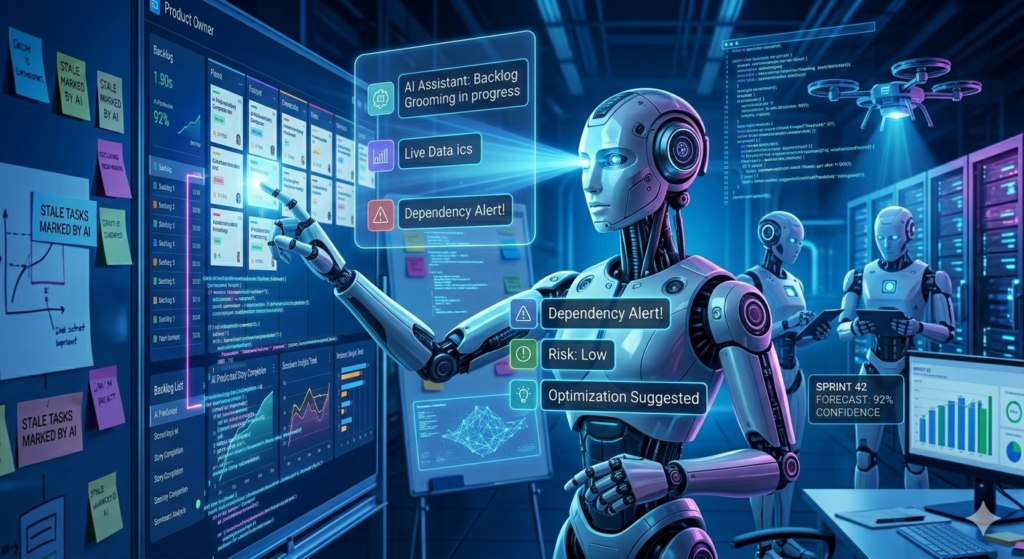
The AI Supported Product Owner Adapting Agile Methods in 2026
Back then, being a Product Owner meant endless rounds of face-to-face talks with stakeholders. Meetings stacked up, one after another, leaving little room to breathe. Decisions came less from data and more from whoever spoke first or loudest around the table. Sometimes a hunch about numbers on paper shaped the whole direction. Choosing what mattered most felt less like planning, more like surviving.
Jump ahead to 2026, and everything runs differently now. Instead of treating generative AI as a side project, teams rely on it like a core member. Not limited to answering messages – it dives into processes, spots patterns in user reactions, shapes task details, even flags problems long before deadlines arrive. This isn’t extra help. It’s built in, expected, always on.
Truth is, AI won’t steal your role. Instead, it takes over the chores you found tedious. Change like this clears busywork that weighed down Product Owners. Now they can focus again on meaningful challenges. Big picture thinking fits them better anyway.
The New Agile Toolkit AI for Product Owners
By 2026, one AI-driven Product Owner runs on a web of smart tools. Not just prompts anymore – instead, systems that fit together like puzzle pieces
- With Jira AI and ADO extensions, dependencies pop up before they cause trouble. Instead of waiting, readiness criteria appear right when needed. One moment you’re planning, next thing – you’re prompted to review what matters. These quiet nudges help teams stay ahead, not just react. Clarity shows up early, embedded in the flow. Small alerts, big difference in how work moves.
- Out there, some tools chew through heaps of app store feedback and customer support messages. These spot recurring frustrations as they happen. Top complaints rise fast when machines sort the noise. Real patterns show up by watching what users actually say. Three big issues stand out once the flood gets filtered daily.
- That “must-have” feature might not land when expected. Models powered by artificial intelligence study past team speed. Nine times out of ten, they spot if a goal is realistic for the sprint. Numbers from earlier work guide the forecast – no guesswork needed.
Generative AI Changing How Product Owners Work
1. Smarter Backlog Management and Hygiene
Out of sight, a cluttered backlog quietly chokes progress. These days, artificial intelligence steps in like a careful organizer. Duplicates get spotted easily. Stale tasks – left untouched past half a year – are marked without delay. Themes begin to form naturally through smart clusters suggested by the system. Rather than wrestling with spreadsheets for nearly half a day, product owners now skim refined summaries within a quarter hour.
2. High Fidelity User Stories Fast
Most people need to write user stories, yet starting from zero takes too long.
AI Generated Story Example
- User Persona: Premium Subscriber.
- Requirement: One-click refund for digital goods.
- Out of nowhere, a system writes the full story along with five sharp acceptance rules – covers odd moments such as expired credit cards. It quietly slips in API notes fit for developers, no fanfare. While most skip details, this one layers them without clutter. From the start, it assumes nothing, builds each piece like it matters. Even when listing tech needs, it stays grounded, never floating off into vague ideas.
3. Smart tools for team planning and reviews
During planning, AI can simulate different “what-if” scenarios. “If we pull in the checkout redesign, what is the impact on the loyalty program launch?”
On Tuesdays, code reviews drag on – forty percent slower than usual – a clue buried in Jira notes and chat logs. Machines spot these hiccups first, quietly sifting through daily updates and messages. A pattern emerges, then someone asks: was it meetings? workload? timing? The data does not decide. People do.
The Human Edge What Makes You Unique
Ai Manages Data But Not Decisions
- What if machines tried to sense irritation in someone’s voice? A computer might miss the tension in a person’s words when they speak. Even with perfect audio, emotional cues slip past algorithms. Real annoyance lives outside data points. Machines hear syllables, not sighs. Feeling understood is different from being analyzed.
- Picture this. A tool could push an update boosting income while quietly slipping past personal boundaries. Here stands the product owner, deciding what feels right. Not every gain deserves pursuit. Choices ripple outward. Someone must weigh those waves before they spread.
- Here’s the thing – AI can’t sense tension when the Head of Marketing hesitates over Q4 funds. Gaining real agreement still comes down to people reading between the lines.
AI ehics and limits in agile
Here’s the truth no one wants to touch – AI makes mistakes, just like any tool built by people.
- Out of nowhere, an AI could claim a rule that isn’t real. Sometimes it makes up limits where none are set. A system may state a restriction that was never defined. From thin air, false boundaries appear in its responses. It can assert a limitation that simply isn’t there.
- When data leans one way, so does the AI sorting tasks. A tilt in what you feed it pulls results off balance. Feeding uneven examples leads to lopsided outcomes. Skewed inputs shift priorities without warning. Out of whack learning means choices drift silently. What goes in warped comes out tilted. Uneven foundations shape decisions quietly.
- One wrong move could expose your company’s plans forever. Picture this – confidential details vanishing into an AI’s memory without warning. By 2026, knowing how to handle prompts safely isn’t optional anymore. Slip once, face consequences that last years. Hidden risks live in every query sent online. Guarding information becomes second nature for anyone using smart tools openly.
How AI-Native Product Managers May Shape Future Careers
Whoever handles products later will likely work closely with artificial intelligence. Writing computer programs isn’t required – understanding how AI thinks matters more.
Now it’s less about having a Scrum badge on your resume – what stands out is knowing how to read data, shape smart prompts. Folks who link real-world goals with what AI can actually do? They’re pulling ahead, pay-wise, by roughly a quarter more come 2026.
Key Takeaways
- Documents get written faster when machines handle them instead of people. User tales plus checklists come together without manual work. Information pieces link up through smart systems behind the scenes. Speed improves because steps happen one after another automatically.
- Strategy: POs shift from “Project Coordinators” to “Product Strategists.”
- Here is where numbers meet meaning. Machines show what happens next. People explain why it matters. Timing comes from experience, not algorithms. Insights grow when logic pairs with judgment. Answers live in data. Questions come from us
- Starting with ethics matters most. A Product Owner works to block unfair AI choices, stops information spills too. Guarding trust happens through careful steps, not grand promises. Flaws creep in when attention slips, so staying alert shapes better outcomes. Protecting people means checking systems, again and again.
- Learning never stops. Right now, shaping prompts and reading AI data sit at the heart of Agile work. Skills shift fast – these ones matter most.
Living in an Augmented World
Now things move differently. The word “Agile” means something again. Machines handle the grind of sorting information. That leaves room – space opens up – for asking better questions, listening closely to people involved, trying ideas that seem too far at first glance.
One step ahead in 2026 are Product Owners using AI to boost gut instinct, not just tidy sheets. Tools shift fast – yet one thing holds steady: real value lands with users first. Leadership now means moving with smart machines beside you.
Frequently Asked Questions About Generative AI in Agile
Q1: Will AI eventually replace the Product Owner role?
No. AI can generate options, but it cannot take accountability. The “Owner” in Product Owner is about responsibility, vision, and human negotiation—things AI cannot replicate.
Q2: What is the best AI tool for writing user stories?
In 2026, Jira’s native AI and specialized tools like Jasper or ClickUp Brain are leaders, but many POs use custom-tuned GPT models specifically trained on their company’s style guides.
Q3: How does AI help with stakeholder management?
AI can transform technical sprint data into high-level “Executive Summaries” or “Release Notes” tailored for non-technical audiences, ensuring everyone is aligned without the PO writing five different emails.
Q4: Is it safe to put company data into Generative AI?
Only if you are using “Enterprise Grade” AI instances (like Azure OpenAI or private Claude deployments) that guarantee data isn’t used for training. Always check your company’s AI governance policy.
Q5: What’s the first step for a PO to start using AI?
Start with “Backlog Grooming Assistant” prompts. Feed your AI a rough feature idea and ask it to generate five “As a user…” stories with acceptance criteria. Refine them and see how much time you save!