
Introduction
Most folks believe the Scrum Master’s job is just running morning huddles along with setting up meeting times.
Yet things turn out nothing like that.
Every now and then, a Scrum Master steps in when teamwork wobbles – guiding without taking charge. On certain mornings, tension between members needs smoothing out quietly. Leadership groups sometimes miss how their choices ripple through daily work; that’s where support shifts into teaching mode. Other times, progress stalls because of outside delays or unclear requests piling up. Removing those snags becomes the main task before anything else moves forward.
Each day brings something different. What happens tomorrow never copies today. Even small shifts change how things feel. One moment lines up nothing like the next. Time moves without repeating itself.
These days, companies everywhere are trying Agile ways of working. So the job of a Scrum Master keeps shifting, changing shape often. Not just guiding meetings but listening closely, stepping in when needed. One moment they’re clearing roadblocks, next they’re asking questions that spark new thinking. Improvement isn’t a goal set far away – it happens daily, in small moves. Leadership shows up quietly, through how they show up.
What really happens during an ordinary day?
Let’s explore the real day-to-day life of a Scrum Master in 2026.
Scrum Master Role Explained?
It’s up to the Scrum Master, under Scrum rules, to back and grow how Scrum works across teams. While guiding practices, they help keep its ideas alive where people work.
A Scrum Master works within teams to support process and collaboration
- A coach
- A facilitator
- A servant leader
- A mentor
- A problem solver
- A team enabler
Most of their job does not involve overseeing others.
What they actually do is clear roadblocks so teams can move faster. Helping people work better together comes next. Following Agile the right way matters just as much.
Smooth progress comes easier when someone guides the team through each step. Moving forward together shows in how people collaborate across roles. Progress takes shape because one person supports developers, product owners, others involved. Shared direction grows without force, just steady help along the way.
Understanding Servant Leadership
Folks who lead by serving come first in Scrum. That idea matters more than almost any other.
Not like old-school bosses barking orders, a Scrum Master guides by helping the group move forward together. Instead of pushing from the front, they step in where needed, clearing paths so work flows easier. While some leaders rule with strict plans, these ones listen more than they speak. Without giving directions constantly, their strength lies in stepping back at times. Leadership here feels less like authority, more like support woven into daily effort.
This means:
- Helping team members overcome blockers
- Supporting collaboration
- Encouraging transparency
- Creating a healthy work environment
- Empowering teams to make decisions
A Scrum Master leaves the team to steer itself.
That way, the group can work more smoothly together.
Trust grows when leaders support honest feedback loops within Agile groups. Responsibility sticks around because people own their actions more openly. Progress keeps moving since learning never really stops there.
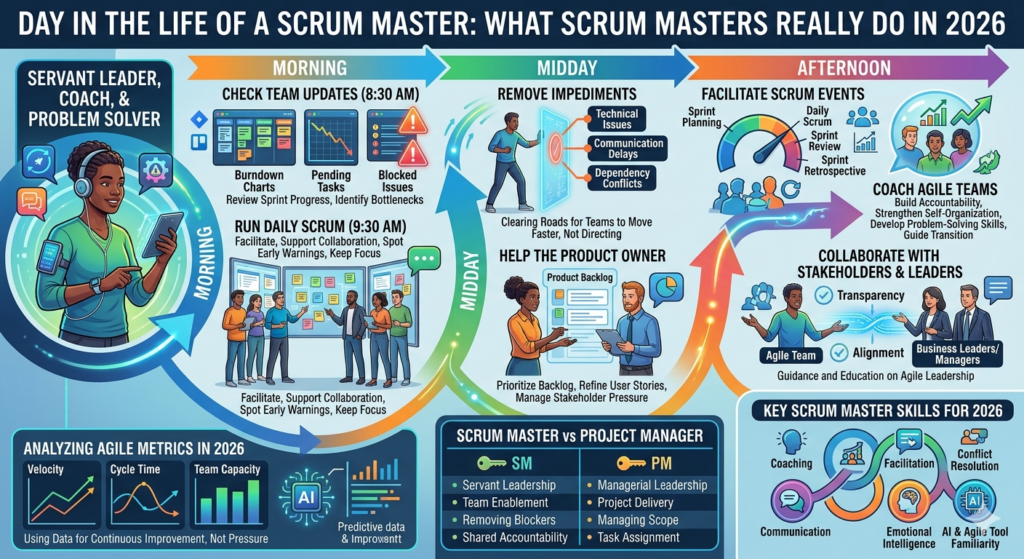
Checking Team Updates Each Morning
Early morning finds the Scrum Master reviewing how far the team has moved.
They may review:
- Sprint boards
- Burndown charts
- Pending tasks
- Blocked issues
- Team updates
- Sprint goals
What keeps Scrum Masters informed about team progress? Tools such as Jira, Trello, or Agile dashboards show real-time status. Their clarity comes from tracking tasks visually. Each platform reveals bottlenecks before they grow. Progress isn’t guessed – it’s seen. Updates appear instantly across boards. Team members update work, others observe shifts. These systems turn daily effort into clear patterns. Without them, confusion spreads faster than news.
Most mornings, well ahead of the team’s huddle, the Scrum Master is already scanning for snags that might slow things down. A quiet check here, a quick note there – small moves that keep progress steady. Often, problems are spotted long before anyone logs into the call. With eyes open early, delays get flagged while others are still grabbing coffee. This head start makes space to adjust without panic later on.
Running the Daily Scrum
Among well-known Scrum practices stands the Daily Scrum, sometimes called the Daily Standup.
During this short meeting, team members discuss:
- Last night’s finish line crossed what they wrapped up just yesterday
- What they’re working on today
- What’s slowing them down right now
Focused on keeping things moving, a Scrum Master guides the team through each discussion. Productivity tends to improve when distractions fade into the background. The rhythm of the session often follows where attention gets placed. Clarity grows when someone watches the flow and adjusts as needed.
Still, they’re meant to stay back during talks.
Communication flows better because they guide how people work together. Teamwork grows when there is support like theirs.
A strong Scrum Master spots quiet warning signs before they grow – misaligned messages, tangled dependencies, fuzzy goals. Early detection keeps things moving without drama.
Removing Impediments
Stopping roadblocks? That falls right into a Scrum Master’s lap. Most of their weight shows up here – clearing what slows things down.
These blockers can include:
- Technical issues
- Communication delays
- Dependency conflicts
- Resource shortages
- Unclear requirements
- Organizational bottlenecks
For example:
Someone coding could sit idle without proper access rights. Meanwhile, progress often halts when key people delay their sign-off.
A sudden shift happens when roadblocks appear – someone must step in. That role falls to the person guiding the process, clearing obstacles before momentum fades. Speed matters because delays pile up silently. Progress stays steady only if interruptions vanish fast. The flow returns once hurdles are gone.
That’s part of what makes Scrum Masters seen as people who help teams move forward. They clear paths, not lead from front
Helping the Product Owner
Throughout the sprint, Scrum Masters walk step by step beside Product Owners. While one focuses on pace, the other keeps sight of goals – both moving together. Because each role leans into the other, progress finds its rhythm naturally.
Help could come in forms like these
- Helping prioritize the Product Backlog
- Facilitating backlog refinement sessions
- Improving user story clarity
- Assisting with Sprint Planning
- Encouraging stakeholder collaboration
Sometimes Product Owners face pressure from multiple business stakeholders.
Now here’s a different way forward – keeping things lined up comes down to how well daily efforts match the sprint target, along with what matters most to customers. Balance shifts smoothly when each step ties back to real outcomes instead of just ticking boxes.
Facilitating Scrum Events
Scrum Masters facilitate several Agile ceremonies during the sprint cycle.
These include:
Sprint Planning
Starting each sprint by shaping clear targets alongside the team. Picking tasks from the backlog that fit the bigger picture. Moving forward only when everyone sees the point.
Daily Scrum
Ensuring productive daily collaboration.
Sprint Review
Showing examples while collecting thoughts from those involved. Sometimes people share ideas after seeing how things work in practice.
Sprint Retrospective
Looking at what’s working, while noticing where things slow down. Team members spot shifts that matter, yet pause to question roadblocks they hit. Each step forward comes with a glance back, just to see what held them up before.
A strong Scrum Master goes beyond just setting up meetings.
Value comes out of each Scrum gathering because they make it happen. Each moment matters when these moments are shaped right.
Take sprint retrospectives – they can drift into dull loops. A Scrum Master guides the team toward real changes instead. Not repetition, but shifts that stick.
Coaching Agile Teams
Coaching teams fills much of a modern Scrum Master’s workday. Often, time slips away in conversations that shape how groups solve problems. Some days tilt heavily toward listening rather than leading. A rhythm forms around helping others find clarity. Moments of progress appear quietly, between questions. Guidance becomes the steady undercurrent of daily effort.
This involves supporting those on the team
- Understand Agile principles
- Improve collaboration
- Build accountability
- Strengthen self-organization
- Develop problem-solving skills
It can happen that people on the team push back when Agile methods are first introduced.
The Scrum Master guides them through the transition patiently.
It’s sharp coaching ability that draws a line between okay Scrum Masters and those who really stand out.
Collaborating with Stakeholders and Leaders
Not just tied to dev squads, Scrum Masters also engage wider groups.
Working together includes these partners
- Business leaders
- Managers
- Executives
- Customers
- Cross-functional teams
Most companies see their leaders sticking to old-school ways of running things. Though newer methods exist, familiar habits stay strong at the top. Where change might be expected, routine often wins instead. Some try updates, yet daily practice leans on what’s been done before. Even under pressure, the rhythm of past actions holds firm.
From time to time, Scrum Masters guide leaders through what Agile really means – its openness, its way of leading by serving rather than directing. Sometimes it clicks fast; other times, it takes repeated conversations. A shift happens when those in charge begin seeing progress differently – not just deadlines met but teams thriving.
Working across both sides, they link Agile groups with company leaders. Sometimes moving ideas back and forth, other times shaping how decisions flow upward. Not always visible, yet present where planning meets execution. Their role appears quietly in meetings, documents, handoffs – moments when speed needs structure. While teams focus on tasks, these figures keep alignment alive through small but steady adjustments.
Supporting Teams in Embracing Agile Practices
When companies shift away from old-style project methods, Scrum Masters help guide the change. Their presence shapes how teams adapt and start working differently. Movement toward Agile often depends on their ability to support new ways of thinking. They step into moments of uncertainty, offering clarity without enforcing rules. Growth happens slowly, through small shifts they encourage each day.
Working on tasks like these could fall under their role
- Training teams on Scrum practices
- Supporting Agile adoption
- Guiding cultural change
- Helping teams adjust to new workflows
- Encouraging continuous improvement
Change moves slow sometimes. Getting used to new ways takes time.
Old routines might hold things back when what’s needed isn’t clear. Change often meets quiet pushback without even a word spoken. Progress sometimes drags because familiar ways feel safer than new ones.
Teams move through tough spots because Scrum Masters show quiet guidance. A leader steps in when confusion slows progress.
Analyzing Agile Metrics
scrum masters track agile metrics
- Velocity
- Burndown charts
- Cycle time
- Team capacity
- Sprint predictability
Patterns show up more clearly when tracked over time. Yet spotting where things can get better often depends on what you measure.
Yet good Scrum Masters steer clear of pushing teams through numbers.
Yet clarity grows when numbers guide reflection rather than judgment. Learning deepens because feedback becomes visible, tangible, something to adjust alongside. Progress shows up not in praise but in small shifts noticed over time.
Technical Talks and Helping the Team
Even if Scrum Masters aren’t tech specialists by default, plenty dive into coding talks these days. Yet their role often shifts toward guiding conversations rather than leading them. Still, helping developers think through solutions shows up more often now. Because of how fast tools change, some find it useful to understand the details. Not every team expects this skill, but when needed, having a grasp helps. So while deep knowledge isn’t required, being able to follow along matters.
They may help teams address:
- Technical debt
- Workflow bottlenecks
- Quality concerns
- Cross-team dependencies
- Process inefficiencies
Still aiming to support the group in creating lasting results.
Scrum Masters often deal with team conflicts lack of stakeholder support unclear goals resistance to change and balancing agility with organizational rules
Working this job might bring satisfaction, yet difficulties show up just the same.
Resistance to Agile
Some teams or managers may resist Agile practices.
Managing Conflicts
Scrum Masters often help resolve interpersonal team conflicts.
Handling Unrealistic Expectations
Faster results could be expected by those involved, even when they overlook how Agile actually works.
Balancing Multiple Teams
Working across multiple teams can stretch a Scrum Master thin. Juggling different groups adds layers of difficulty.
Preventing Burnout
Most days, a steady pace keeps people moving forward without burning out. What matters? Team energy stays high when tasks feel fair. Often, small shifts make effort last longer. Balance shows up where pressure doesn’t build. People stick with work that respects their time.
Facing tough moments takes clear talk, along with a feel for what others experience.
Scrum Master Compared With Project Manager
Many companies still confuse Scrum Masters with Project Managers.
However, their responsibilities, focus areas, and working styles are very different.
| Area | Scrum Master | Project Manager |
| Primary Focus | Team enablement and Agile process improvement | Project delivery and business outcomes |
| Leadership Style | Servant leadership | Managerial leadership |
| Main Responsibility | Removing blockers and supporting the team | Managing scope, timelines, and execution |
| Team Approach | Encourages self-organization and collaboration | Assigns tasks and directs activities |
| Process Role | Facilitates Scrum ceremonies and Agile practices | Creates project plans and tracks progress |
| Success Measurement | Team efficiency, collaboration, and continuous improvement | Project completion within scope, time, and budget |
In Scrum, accountability is shared across the team rather than being controlled by a single individual.
Scrum Master Skills Needed in 2026
When Agile changes, those guiding it must blend know-how with understanding others. Not just one or the other – both matter more together. A shift happens when skill meets empathy. What counts now isn’t only process fluency – it’s how you connect while using it. Behind every method stands someone who adapts, listens, adjusts.
Important skills include:
- Agile and Scrum knowledge
- Facilitation
- Coaching
- Conflict resolution
- Communication
- Emotional intelligence
- Leadership
- Problem-solving
- Adaptability
- AI and Agile tool familiarity
Out of nowhere, some Scrum Masters now tap into AI-driven systems that track how teams work. These tools quietly gather data, shaping better ways to move forward. Instead of guessing, decisions come from patterns found in daily actions. Progress gets clearer when software highlights what slows things down. With each sprint, insights pile up – no fanfare, just shifts based on real behavior. Little by little, routines adapt because feedback loops tighten without extra effort.
Scrum Master Career Outlook 2026?
Still needed, Scrum Masters show up on plenty of job listings these days. Companies keep looking for them, no matter the field.
Agile practices grow in organizations
- IT
- Healthcare
- Banking
- Marketing
- Education
- E-commerce
- Manufacturing
What matters most to businesses? People who boost teamwork, get things done faster, one step at a time improving how Agile works. While results show progress, it’s steady effort that shifts how teams operate together.
With experience, Scrum Masters can grow into roles such as:
- Agile Coach
- Release Train Engineer
- Product Manager
- Agile Consultant
- Delivery Manager
Final Thoughts
Not just standing in daily huddles or running sessions fills a Scrum Master’s hours.
When challenges come up, they step in to clear the path. Teamwork grows stronger because communication shifts in subtle ways. The move toward Agile feels less forced, more natural over time. Spaces form slowly where people do better work without pressure building.
On certain mornings, guiding groups takes up the hours. Sometimes, helping squads fill the schedule instead.
Some days involve solving organizational challenges.
Some days mean pulling away without a word, letting groups find their own rhythm. Quiet moments open space for others to lead. A pause can spark movement where pushing fails. Stillness sometimes does what noise never could.
What keeps Scrum Mastery tough also gives it meaning.
Scrum Master might just fit those drawn to guiding teams, sharing ideas, growing skills – especially if leading feels natural. Beyond 2026, this role stays strong among Agile paths where connection and growth matter.