
A Question Worth Taking
A Scrum Master in the middle of her career contacted me a few months ago with a question that I have been hearing a lot lately:
“Will I be automated out of a job in the next five years?”
She had been working with Agile for eight years. Had a lot of experience. She had her CSM and CSPO certifications had been through two Agile transformations and was leading a team at a company that was growing fast and had just started using three different AI tools in their development workflow.
She was not worried. She was just asking a question that deserved a good answer.
I told her what I really think:
The role of the Scrum Master is not going away.. What makes a great Scrum Master is changing in important ways. And the professionals who understand this change early will have a big advantage in their careers.
Lets talk about what this change looks like.
The Honest Forecast: What AI Can and Cannot Do in Agile
People are talking a lot about AI in Agile. Sometimes it is hard to understand what is really going on.
So before we talk about what the future Scrum team will look like lets be clear about what AI can do right now. And what it cannot do.
Where AI is Really Helpful
AI is great at looking at a lot of data and finding patterns.
In Agile this means it can:
- Look at trends in velocity
- Find problems that keep happening
- Suggest backlog items that are not getting done
- Predict when things will be delivered if the team stays the same
It can also:
- Create drafts of user stories from product requirements documents
- Suggest acceptance criteria based on similar stories
- Find potential risks in sprint plans based on how the team has done in the past
These are contributions. Not small ones.
Where AI Has Problems
When a Scrum team runs into something that does not fit the pattern:
- A team conflict
- A change in business priority
- A stakeholder relationship that needs management
- A developer who is quietly getting burned out
- A sprint goal that needs to be changed because the market just changed
AI does not just do a bad job.
It becomes useless.
In Agile the moments that do not fit the pattern are the moments that matter most.
Sprints that go smoothly do not need a Scrum Master. They just need a calendar.
It is the sprints that hit problems where human leadership makes all the difference
The Future Scrum Team: What It Actually Looks Like
Imagine a Scrum team in 2027.
Here is what their workflow might look like. Not in a science fiction way. In a realistic way based on what is happening now.
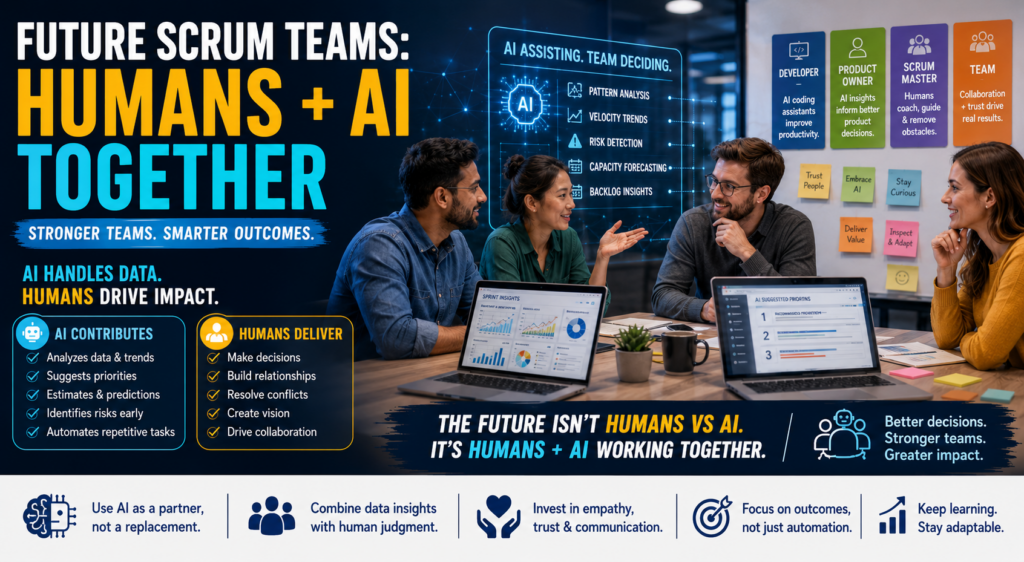
Developers
The developers are working with AI coding assistants that’re really good.
They are:
- Writing code
- Getting better suggestions for test cases
- Getting feedback on their code automatically
They are still:
- Making all the important decisions
- Navigating the hard cases
- Solving problems in creative ways
Product Owner
The Product Owner is using AI-driven analytics dashboards that look at:
- Customer feedback
- Usage data
- Market signals
These tools suggest what to prioritize.
These suggestions inform decisions. They do not make them.
The Product Owner still:
- Owns the vision
- Manages stakeholder relationships
- Makes decisions about what to build and why
Scrum Master
The Scrum Master is the teams guide through a complex environment.
They are not just running meetings.
They are:
- Looking at AI suggestions critically
- Coaching the team on when to trust the data
- Helping teams know when to override AI recommendations
- Managing the dynamics that AI cannot see
What is interesting about this picture is that it is not really different from the Agile teams working today.
The tools are more powerful. The data is better.. The human roles are still uniquely human.
Will AI Replace Scrum Masters? The Real Answer
Lets just say it clearly:
No.
It will show which Scrum Masters were really adding value and which ones were just running meetings.
This is a truth that the Agile community does not always talk about openly.
There are Scrum Masters whose whole job’s:
- Scheduling meetings
- Maintaining Jira boards
- Making burndown charts
That work can be automated.. In many companies it is already being automated partially.
The Scrum Masters Who Will Stay Valuable
The Scrum Masters who are really irreplaceable are the ones doing the work:
- Coaching individuals
- Building trust
- Facilitating hard conversations
- Removing organizational problems
- Helping teams really think in an Agile way
- Not just following Agile rules
That work requires intelligence, trust and judgment that no current AI system can replicate.
The future of Scrum Master training is already changing to focus on this reality.
The best programs are spending time on:
- Coaching skills
- Facilitation
- Organizational dynamics
Because those are the skills that will matter most as AI handles more of the process-level work.
Emotional Intelligence: The Skill AI Cannot Touch
There is a concept in psychology called “Theory of Mind”.
The ability to understand that other people have beliefs, intentions and perspectives than your own.
It is essential to:
- Empathy
- Trust
- Effective communication
AI systems do not have Theory of Mind.
They can simulate it in scripted interactions..
But in the messy emotional dynamics of a real Agile team:
- A developer who feels their concerns were ignored in planning
- A Product Owner who is frustrated that the team keeps missing sprint goals
- A stakeholder who is losing confidence in the teams delivery
AI cannot understand the situation.
It cannot
- Build trust
- Fix relationships
- Understand emotional tension
Every Agile coaching engagement I have been part of eventually comes down to people dynamics.
Teams do not fail because they chose the wrong sprint planning format.
They fail because:
- Humans are not communicating well
- Trust has been damaged
- There is misalignment on goals
- Nobody felt safe enough to talk openly
That is the area where human Agile professionals earn their money..
It is also an area that is only going to become more valuable as companies realize that using AI tools does not automatically fix the human problems that were already there.
What the Future Product Owner Looks Like
The Product Owner role’s changing in interesting ways because of AI.
And it is worth looking at separately because the changes are significant.
Product Owners in 2026 who are doing well have developed what you might call:
“AI Literacy”
The ability to look at a lot of AI-generated insights and turn them into a coherent product strategy.
This is actually a harder job than it used to be.
Having more data does not make decisions easier.
It often makes them harder because you have to know:
- Which signals matter
- Which insights to ignore
- Which recommendations deserve attention
The Product Owner who can navigate that complexity..
Who can look at an AI suggestion and say:
“I understand why the data says that but heres why we’re going in a different direction.”
Is extremely valuable.
Product Owner certification programs that are ahead of the curve are starting to include:
- Data literacy
- AI tool fluency
- Agile product management skills
If you are considering a Product Owner course in 2026 that is something worth looking for.
AI-Driven Collaboration Tools: Changing Team Communication
One of the interesting developments in Agile workplaces is how AI is changing team communication.
Not just planning.
AI-powered meeting assistants can now:
- Summarize standups
- Capture action items from retrospectives
- Find recurring themes across team discussions
Tools integrated with Slack or Teams can:
- Find “forgotten” commitments
- Detect communication patterns that might indicate team tension
- Suggest when a real conversation might be better than a long message thread
For distributed and hybrid teams.. Which is most teams in 2026.. These tools are really useful.
They reduce the effort of staying aligned across:
- Time zones
- Communication channels
- Distributed teams
But Here’s What AI Cannot Do
It cannot replace the trust that builds when a team has good conversations.
The AI might capture that a commitment was made..
But it was the human connection in the conversation that made the commitment feel meaningful.
Agile leadership in the AI era is about knowing:
- Which conversations need to happen with humans in real time
- Which can safely be managed with AI-assisted tools
Skills Agile Professionals Need in 2026 and Beyond
Based on where the most successful Agile teams are heading here are the skills that will define career paths:
Critical AI Literacy
Not deep technical AI knowledge.
But the ability to:
- Evaluate AI suggestions intelligently
- Understand their limitations
- Communicate clearly about when AI output needs human override
This is essential for professionals in the next few years.
Advanced Facilitation and Coaching
As process-level tasks get automated the value of human facilitation rises.
The Scrum Masters and Agile coaches who can:
- Run transformative retrospectives
- Navigate team conflict with skill
- Build psychological safety
Will be in higher demand, not lower
Systemic Thinking
When an Artificial Intelligence tool is telling you:
- What to do for a sprint
- How fast you can get things done
- Which tasks might become problems
And the team just goes along with it without talking about it..
That is not a good thing.
It makes team members feel like they should not speak up even if they know something that the Artificial Intelligence tool does not.
The good Agile coaches I know are dealing with this issue.
They:
- Make sure team members feel comfortable questioning AI suggestions
- Encourage team members to share their knowledge and ideas
- Help people trust their judgment even when the data says something else
Conclusion
The future of Agile is not really about humans versus AI.
It is about humans learning how to work with AI without losing the collaboration, communication and critical thinking that make Agile valuable in the first place.
The professionals who will grow the most in the next few years will not be the ones trying to automate everything.
They will be the people who understand where AI helps.. And where human leadership still matters more.