
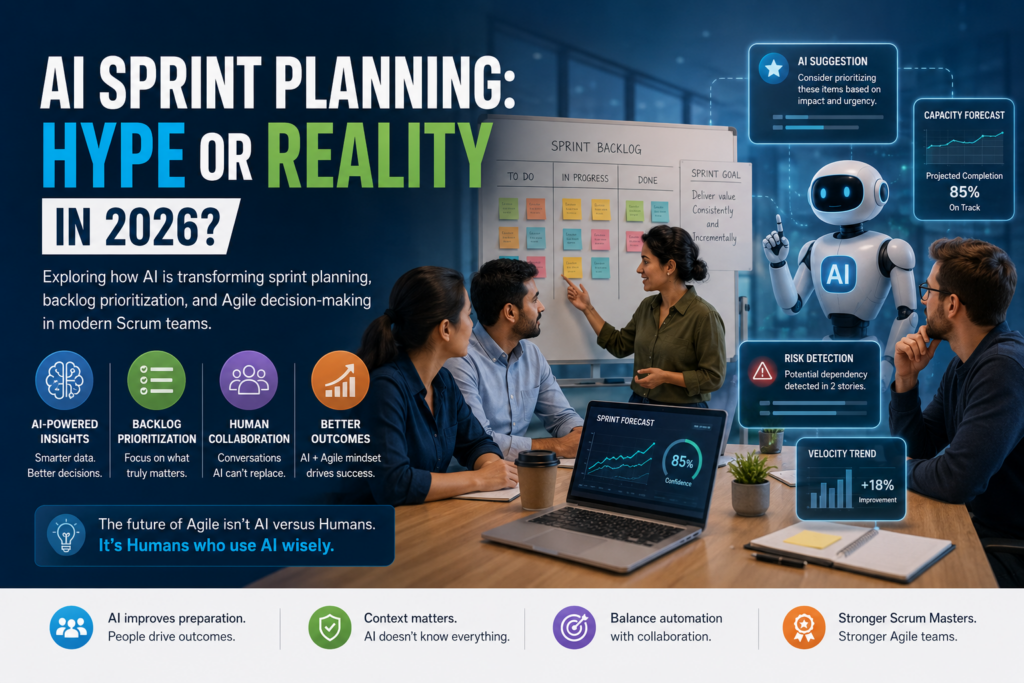
The Honest Conversation Nobody’s Having About AI and Agile
Walk into any Agile conference in 2025 or 2026 and you will notice a pattern.
Someone on stage is confidently talking about how AI’s changing sprint planning, reinventing Agile or replacing manual workflows forever. Half the room looks excited. The other half looks slightly uncomfortable. Quietly wondering whether their role in the team is slowly changing in ways nobody fully understands yet.
Honestly both reactions make sense.
After speaking with Scrum Masters, Product Owners, Agile Coaches and delivery teams across industries one thing has become very clear: the conversation around AI in Agile is either massively overhyped or completely dismissed.
Few people are talking about the reality in the middle.
Because yes AI is changing sprint planning. Some of those changes are genuinely useful. Some are creating new problems for Agile teams. The teams succeeding right now are not the ones blindly automating everything. They are the ones learning where AI actually helps and where human collaboration still matters more.
That’s the conversation worth having
What AI-Powered Sprint Planning Actually Looks Like Today
A lot of people imagine AI-powered sprint planning as some robot running Agile ceremonies.
The reality is less dramatic. And much more practical.
In Agile teams today AI tools are quietly becoming assistants during:
- Backlog refinement
- Sprint planning
- Reporting
For example, tools integrated with platforms like Jira or Azure DevOps can:
- Suggest user story structures
- Generate acceptance criteria
- Recommend story point estimates
- Identify possible dependencies
- Analyze sprint velocity trends
- Summarize patterns
- Suggest sprint goals based on data
Some Product Owners are even using ChatGPT to draft backlog items before refinement sessions.
To be fair some of this is genuinely helpful.
A Product Owner who once spent hours organizing backlog notes can now create drafts within minutes. Scrum Masters can quickly identify recurring delivery bottlenecks without reviewing six sprint reports.
That’s productivity improvement.
Here’s where things get complicated.
Where AI Is Actually Helping Agile Teams
Faster User Story Creation
Let’s be honest. Writing user stories repeatedly can become exhausting.
Especially in moving Agile environments where priorities change constantly.
AI tools are making this easier by helping teams generate drafts quickly. A Product Owner can describe a feature idea in language and AI can instantly convert it into:
- User stories
- Acceptance criteria
- Edge cases
- Workflow suggestions
For Agile teams this saves significant time.
Experienced Scrum Masters already know the catch: AI-generated stories often look polished while missing important business context.
That’s dangerous.
Because sprint issues rarely happen due to formatting problems. They happen because teams misunderstand the requirement.
AI can generate documentation. It cannot automatically generate understanding. That part still belongs to humans.
Smarter Backlog Prioritization
One area where AI is becoming surprisingly useful is pattern recognition.
AI backlog prioritization tools can detect trends humans often miss.
For example:
- Features repeatedly delayed across sprints
- Technical debt continuously ignored
- User personas being deprioritized
- Sprint spillovers becoming frequent
- Workload imbalance within teams
A Product Owner manually analyzing this data might spend hours reviewing sprint reports and dashboards.
AI surfaces these patterns instantly.
In large Agile environments that speed genuinely helps.
But there’s a limitation most vendor marketing doesn’t mention:
AI sees patterns. It does not understand context.
It doesn’t know why a stakeholder forced a priority shift last month. It doesn’t understand leadership politics, customer relationships or business pressure happening behind the scenes.
Which means AI recommendations should support decisions. Not replace them.
Better Sprint Capacity Forecasting
This is probably one of the practical uses of AI in sprint planning today.
Modern AI Agile tools can analyze:
- Velocity
- Team capacity trends
- Leave calendars
- Completion rates
- Story complexity patterns
Based on that they predict sprint capacity more accurately than pure gut feeling.
For Product Owners discussing release timelines with stakeholders this creates realistic conversations.
Instead of saying:
“We think we’ll finish this by Q3…”
Teams can now provide probability-based forecasting backed by real sprint data.
That’s an improvement for Agile project management.
The Part Nobody Talks About: AI Is Also Creating New Problems
This is where the conversation gets uncomfortable.
Because while AI improves efficiency it can also quietly weaken the side of Agile if teams aren’t careful.
Honestly some teams are already experiencing this.
Teams Are Thinking Less During Sprint Planning
One of the risks of over-automation is reduced engagement.
When AI:
- Generates the stories
- Suggests estimates
- Recommends sprint scope
- Creates summaries
it becomes very easy for teams to stop discussing the work.
Sprint planning slowly turns into a review session instead of a collaboration session.
Developers assume the AI-generated estimate is probably correct. Product Owners skip refinement because the story “already looks detailed.”
Then halfway through the sprint hidden complexities appear that nobody properly discussed.
This happens more often than people admit.
Because the real value of sprint planning is not the sprint backlog itself.
The value is:
- The conversation
- The alignment
- The shared understanding
AI can accelerate preparation. It cannot replace collaborative thinking.
AI Recommendations Often Miss Real-World Context
Here’s a situation many Agile teams are now facing.
An AI tool recommends including a backlog item in the sprint because:
- It’s high priority
- It’s overdue
- Similar stories were completed successfully before
Sounds logical.
But mid-sprint the team realizes the feature depends on an external vendor API currently undergoing changes. Something not documented anywhere in the tool.
The AI didn’t know. Because it couldn’t know.
Experienced team members usually catch these risks during discussion.
When teams become overly dependent on AI recommendations they stop questioning the output critically.
That’s where problems start.
The Danger of “Standardized Agile”
This is a concern many experienced Agile Coaches are quietly discussing.
If every team uses AI recommendation systems trained on generalized Agile patterns are teams slowly losing their unique ways of working?
Because Agile was never meant to be rigid.
The best Scrum teams succeed because they adapt Scrum to fit:
- Their environment
- Team dynamics
- Customer needs
- Organizational culture
AI optimization naturally pushes teams toward standardized patterns.
While consistency sounds good on paper too much standardization can reduce:
- Creativity
- Experimentation
- Contextual problem-solving
Ironically Agile teams risk becoming less adaptive while trying to become “AI optimized.”
The Scrum Master Role Is Becoming More Important. Not Less
There’s a growing fear that AI will eventually replace Scrum Masters.
In reality AI is exposing why strong Scrum Masters matter even more now.
Because modern Scrum Masters are no longer just meeting facilitators.
In AI-assisted environments Scrum Masters help teams:
- Challenge weak AI recommendations
- Maintain team engagement
- Preserve collaboration quality
- Encourage critical thinking
- Protect psychological safety
- Prevent over-automation
- Keep Agile human-centered
The Scrum Master role is evolving from process facilitator to Agile coach.
Honestly the best Scrum Masters in 2026 are not competing with AI. They’re learning how to work alongside it.
That’s becoming a focus in modern Scrum Master certification programs and Agile certification training as well.
Myths vs Reality About AI
Myth: AI Will Replace Sprint Planning Meetings
Reality:
Sprint planning is fundamentally about team discussion and shared understanding. AI can improve preparation. Not replace collaboration.
Myth: AI-Generated User Stories Are Ready to Use
Reality:
AI-generated stories are drafts. Some are excellent. Some completely miss business context. Human review is always necessary.
Myth: AI Automatically Makes Agile Teams More Productive
Reality:
Strong Agile teams become more efficient with AI. Weak Agile teams simply automate existing problems faster.
Myth: AI Will Replace Scrum Masters
Reality:
AI handles tasks. Scrum Masters handle people, collaboration, culture, conflict resolution and team dynamics. Things AI still struggles to understand.
What This Means for Agile Careers in 2026
The professionals growing fastest right now share one important trait:
They understand both Agile principles and AI tools.
Not blindly. Critically.
That’s the difference.
Modern Agile leadership increasingly requires professionals who can:
- Use AI tools effectively
- Evaluate AI recommendations intelligently
- Balance automation with collaboration
- Maintain human-centered practices
Whether someone is pursuing:
- Scrum Master certification
- Product Owner certification
- Agile coaching
- SAFe certification
- Agile leadership roles
AI literacy is slowly becoming part of the expected skill set.
Agile fundamentals still matter more.
Because AI cannot fix:
- Collaboration
- Poor communication
- Weak leadership
- Unhealthy team culture
It only amplifies what already exists.
AI-powered sprint planning is not hype.
Final Thoughts
It’s also not the magical Agile revolution many vendors claim it is.
The truth lies somewhere in between.
Artificial Intelligence is really helping teams with things like:
- Getting backlog ready faster
- Analyzing data smartly
- Forecasting better
- Doing admin tasks efficiently
But at the same time its also bringing some risks:
- Team members not working together much
- Relying too much on automation
- Not thinking enough
- Team members not being as engaged
That’s why the future of Agile is probably not about “AI versus Humans”.
It’s about humans who know how to use AI in a smart way.
The Scrum Masters and Product Owners who do well in the next few years will be the ones who don’t try to automate everything.
They’ll be the professionals who understand:
- When automation is helpful
- When people working together is more important
Because Agile is really about people, not tools.