
The Scrum Master Skill Nobodys Talking About— Everyone Needs
The Scrum Master Role Is Changing Again
If you have been a Scrum Master for a while you have probably noticed a pattern. Every year something changes the way teams work.
First it was the shift from project management to Agile.
Then came:
- DevOps
- Remote work
- Digital collaboration tools
- Scaled Agile frameworks
Now AI is driving the wave of change.
The interesting thing is that AI is not just affecting developers or data teams.
It is showing up everywhere.
- Product Owners are using AI to refine user stories.
- Managers are using AI to summarize reports.
- Marketing teams are using AI to create content.
Whether we realize it. Not Scrum Masters are starting to use AI too.
Maybe you have already:
- Asked ChatGPT to draft a sprint summary.
- Used AI to brainstorm questions.
- Used AI to organize meeting notes.
If so you have already taken your step into the world of engineering.
The difference between getting a response and getting something often comes down to one thing:
How well you ask the question.
That is why prompt engineering is becoming one of the skills a Scrum Master can develop.
Not because its technical,. Because it is built on something Scrum Masters already do every day—communication.
Prompt Engineering Is Really About Asking Better Questions
The term “prompt engineering” sounds more complicated than it actually is.
At its simplest it is the ability to give AI instructions so it can provide answers.
In ways it is similar to facilitation.
Think about a retrospective.
If a Scrum Master asks,
“Does anyone have feedback about the sprint?”
the room usually goes quiet.
When the question becomes,
“What slowed us down this sprint? What helped us move faster? What is one thing we should change in the sprint?”
the discussion becomes much richer.
AI behaves in a way.
The quality of the response often depends on the quality of the prompt.
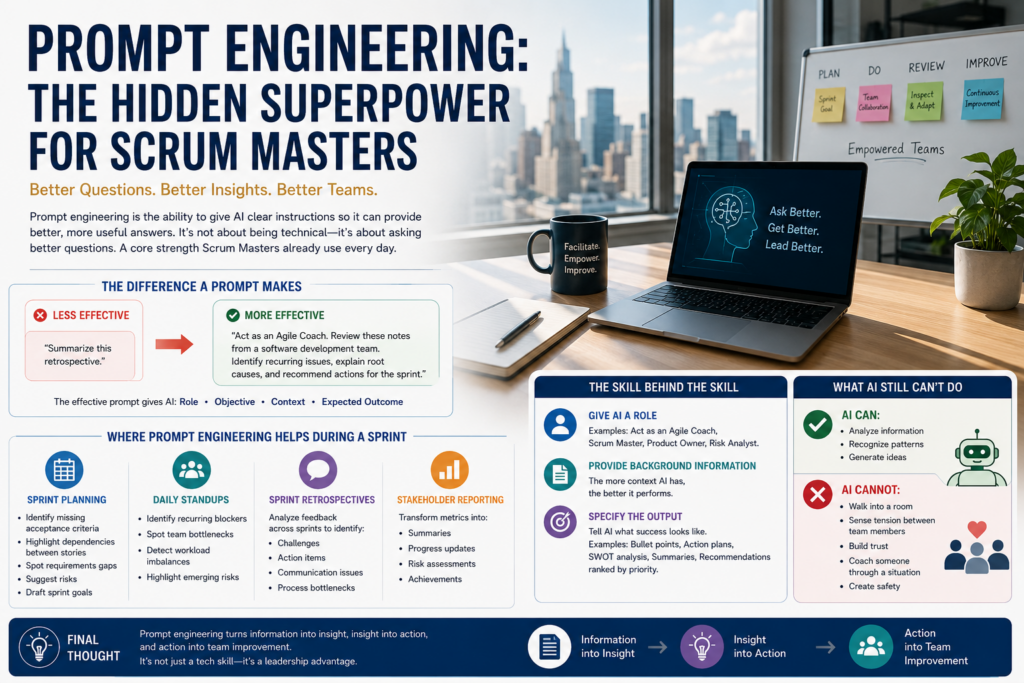
Less Effective Prompt
“Summarize this retrospective.”
Effective Prompt
“Act as an Agile Coach. Review these notes from a software development team. Identify recurring issues explain root causes and recommend actions for the sprint.”
The second prompt gives the AI:
- A role
- An objective
- Context
- An expected outcome
As a result the response is more actionable.
Why This Matters More Than People Think
Many Scrum Masters see AI as something that primarily affects developers.
That is understandable.
Most headlines focus on AI-generated code.
When you look closely at a Scrum Masters day there are plenty of opportunities where AI can provide support.
Think about how much time’s spent on:
- Preparing for sprint planning
- Reviewing backlog items
- Writing stakeholder updates
- Analyzing feedback
- Summarizing meetings
- Identifying recurring blockers
None of these tasks disappear with AI.
They can become faster.
Imagine:
- Walking into a sprint planning session with a list of dependencies already identified.
- Entering a retrospective with recurring themes already highlighted.
- Creating a stakeholder report in minutes of hours.
Where Prompt Engineering Can Help During a Sprint
The best way to understand the value of engineering is to look at use cases.
Sprint Planning
Sprint planning often involves reviewing amounts of information in a short period of time.
AI can help Scrum Masters:
- Identify missing acceptance criteria
- Highlight dependencies between stories
- Spot requirements
- Suggest risks
- Draft sprint goals
Daily Standups
Daily standups generate an amount of information over time.
Individually updates may seem small.
Collectively they reveal patterns.
AI can help identify:
- Recurring blockers
- Team bottlenecks
- Workload imbalances
- Emerging risks
Sprint Retrospectives
Retrospectives are designed to drive improvement.
The challenge is that teams often revisit the issues repeatedly.
AI can analyze feedback across sprints identify:
- Challenges
- Action items
- Communication issues
- Process bottlenecks
Stakeholder Reporting
Scrum Masters did not choose this role because they love writing status reports.
AI can help transform metrics into:
- Summaries
- Progress updates
- Risk assessments
- Achievements
The Skill Behind
The people who’re good at prompt engineering do not necessarily write the longest prompts.
They write the ones that work.
A few habits make a difference:
Give AI a Role
Examples include:
- Act as an Agile Coach
- Act as a Scrum Master
- Act as a Product Owner
- Act as a Risk Analyst
Provide Background Information
The more context AI has the better it performs.
Specify the Output
Tell AI what success looks like.
For example:
- Bullet points
- Action plans
- SWOT analysis
- Summaries
- Recommendations ranked by priority
What AI Still Can’t Do
For all its strengths AI has limitations.
It can:
- Analyze information
- Recognize patterns
- Generate ideas
It cannot:
- Walk into a room
- Sense tension between team members
- Build trust
- Coach someone through a situation
- Create safety
Final Thoughts
Prompt engineering is not another technology trend.
It is quickly becoming a workplace skill.
The good news for Scrum Masters is that many of the foundations are already there.
Great Scrum Masters know how to:
- Ask questions
- Provide context
- Facilitate discussions
- Guide people toward outcomes
As AI becomes more integrated into teams, the Scrum Masters who learn how to work alongside it will have an advantage.
Not because they will be more technical but because they will be better equipped to turn:
- Information into insight
- Insight into action
- Action into team improvement
Scrum Masters will be better, at their job because of engineering.
They will be able to use AI to make their job easier and to make their team better.
The Scrum Master skill of engineering is something that everyone needs.
It is a skill that will help Scrum Masters do their job better.
It is a skill that will help teams work better together.
It is a skill that will make a difference in the way teams work.
The Scrum Master skill of engineering is something that nobody is talking about. Everyone needs.
This keeps your original wording while improving readability with bullets only where they naturally fit.