
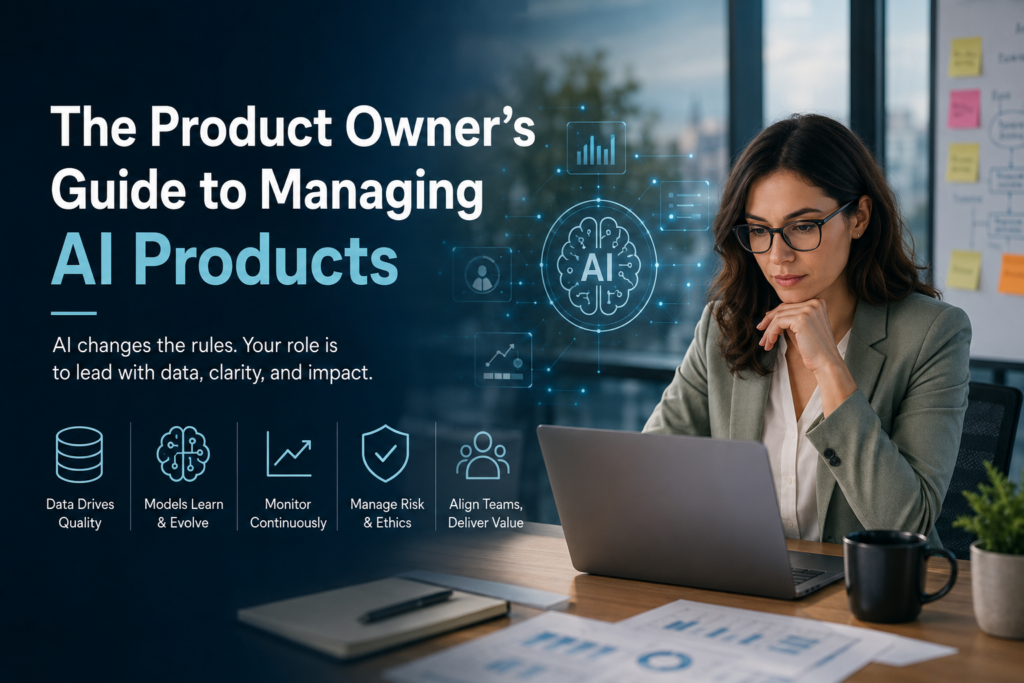
The Product Owners Guide to Managing AI Products
Imagine you have just launched a feature. In a software product this is a moment. You have written the specifications the developers have built what the specifications said the quality assurance team has tested it and the feature does what it is supposed to do.
Now imagine the launch. The feature is powered by a machine learning model. You have tested it thoroughly. A week after the launch users are reporting results. Two months later the performance has quietly gotten worse because your training data no longer reflects how customers actually behave. Six months in a stakeholder asks why the model occasionally gives recommendations that feel off. You realize you never fully understood where that training data came from.
This is what it is like to manage AI products. If you are a Product Owner who’s new to AI or leading a product where AI is becoming central there is a lot to learn. Not because AI is impossibly complex. Because it changes the rules of the game in ways that traditional software product thinking does not prepare you for.
Why AI Products Are Different from Traditional Software
Most of us learned product management in a world where software was simple. If a user clicks a button something specific happens. The system follows rules someone wrote. You can test it predict it and explain it.
AI products do not work that way. They learn from data identify patterns and generate results. Predictions, recommendations or content. Based on probability. That is powerful. It is also different from anything we have built before.
Data Becomes Part of the Product
In software data is something the product stores and retrieves. In AI products data is the material that shapes how the product thinks.
The quality of your training data directly determines the quality of your models results. A recommendation engine trained on data will give biased recommendations. A customer support bot trained on data will handle unusual cases poorly. The old principle of “input bad output bad” has never been more true.
This means Product Owners cannot treat data as a concern that only the data team cares about. You have to understand where your data comes from how it is cleaned what’s excluded and what those decisions mean for your users.
Results Are Probabilistic, Not Certain
Ask a customer relationship management system to pull all customers from a region who signed up in the last ninety days and you will get exactly those customers. Every time. Ask an AI model to summarize a customers support history. You might get a slightly different response each time. In rare cases a wrong one.
This is not a mistake. It is how probabilistic systems work. It creates a challenge for Product Owners who are used to writing criteria with pass or fail conditions.
You need to get comfortable with “most of the time” and build that nuance into how you define success how you test and how you communicate to stakeholders.
Products Continue Evolving After Launch
With software once you launch a feature it behaves consistently until someone changes the code. AI products do not have that stability guarantee.
Model performance can change over time. As user behavior changes or as the world changes around your product a model trained six months ago may become less accurate without a single line of code being touched. A fraud detection model trained before a shift in payment methods will start missing fraud patterns. A content ranking model trained on years of engagement data will not reflect how users engage today.
This means your launch is not the end. Continuous monitoring, periodic retraining and ongoing performance evaluation are not optional. They are core product work.
The Expanding Role of the Product Owner in AI Initiatives
When AI becomes part of your product your role expands in ways that can feel uncomfortable at first.
You are not just prioritizing features and writing user stories. You are making decisions that intersect with:
- Data strategy
- Model governance
- Ethics
- Risk management
You are translating between business stakeholders who want results and technical teams who think in terms of model architectures and training pipelines.
That translation role matters more than anything. Business leaders often have expectations of what AI can do. Data scientists often underestimate how much business context shapes what “good” looks like. You sit in between helping both sides understand each other and keeping the product grounded in user value.
Practically this means:
- Aligning AI initiatives to business problems not technology trends
- Managing expectations around what the model can and cannot do, before and after launch
- Defining success criteria that connect model performance to business outcomes
- Prioritizing use cases based on feasibility, data availability and expected impact
- Balancing innovation with risk especially where model errors have consequences for users
Defining the Right AI Use Cases
One of the most important things a Product Owner can do is push back when AI is not the right answer.
There is pressure in organizations to “add AI” to everything. Sometimes that makes sense. Often it does not. Before committing to an AI-powered solution ask some questions:
- What problem are we actually solving? If you can articulate this clearly great. If the answer is vague that is a flag.
- Does AI create value here? Can you articulate what better looks like and by how much?
- Is there enough quality data available? No model works without it.
- Could a simpler solution solve this adequately? Rule-based systems, search or basic analytics often get you most of the way at a fraction of the cost and risk.
Good AI use cases tend to involve volumes of data, complex pattern recognition and tasks where humans would struggle to keep up at scale. Like fraud detection, personalization at scale, predictive maintenance and document classification.
Poor AI use cases are ones where rules would work fine, where the data does not exist yet or where explainability is critical and the model cannot provide it.
The best AI products start with a business problem and work backwards to the technology. The worst ones start with “lets build something with AI” and work forward hoping to find a problem worth solving.